
Teacher: Professor Amgad Badewi, Fellow of the Higher Education Academy.
A coach has three overdue portfolio entries and a learner who says the workplace never gives them the opportunity to practise.
By the end of this module, you should be able to complete the following task independently. Role-play a five-minute coaching conversation. Ask an open question, agree an observable workplace action and identify the evidence to review.
Recorded examples of dates, venues and programme processes relate to their teaching edition. Use the current learner agreement and programme schedule for decisions about a specific apprentice.
KBC uses open enrolment for this free course. Register for a learner account and start when you are ready. There are no additional entry checks. Read the learning objectives and study plan to decide whether the course suits your goals.
Choose Start or Continue. Use the curriculum menu to move between topics and reopen completed work. The time beside each unit is a planning allowance, including study and practice. This course has no lesson prerequisites configured. Follow the published sequence so you practise the relevant topic before its assessment. Use the completion button on each lesson to save progress to your learner account.
Self-paced online study. Work through the curriculum in sequence, practise on the fictional case and check your reasoning against the worked response. You can pause and return between units.
| Learning sequence | Plan for | Learning outcome and activities |
|---|---|---|
| Learner Journey | 155 min | Trace a learner’s route from induction to assessment. 2 learning items · 40 assessment questions |
| Ofsted criteria | 51 min | Select evidence of learning across work and training. 9 learning items · 30 assessment questions |
| Mastering the Coach’s Blueprint: Workflow, Performance & Student Engagement | 19 min | Plan a coaching week around learner needs. 2 learning items · 10 assessment questions |
| Enhancing Coach Skills – Template Action Plan1 | 41 min | Turn a coaching goal into an action with an owner. 5 learning items · 18 assessment questions |
| Communicating Changes Checklist_Skills Coach3 | 28 min | Explain a change and check the learner understood it. 3 learning items · 8 assessment questions |
| Withdrawals Matrix Resource Skills Coach4 | 50 min | Explore alternatives before recommending withdrawal. 5 learning items · 20 assessment questions |
| Coach Resource Structuring: the conversation | 28 min | Rehearse an open coaching conversation. 3 learning items · 10 assessment questions |
| Enhancing Coach Skills | 27 min | Use observation and feedback to improve questioning. 3 learning items · 10 assessment questions |
| Apprenticeship Intervention Framework | 18 min | Choose a proportionate intervention and review date. 3 learning items · 8 assessment questions |
| Coaching Standards: Marking & Referral Criteria” | 13 min | Justify marking or referral against published criteria. 2 learning items · 10 assessment questions |
| The Programmes EPA | 52 min | Check readiness against the relevant assessment plan. 6 learning items · 30 assessment questions |
| Apply your learning | 10 min | Role-play a five-minute coaching conversation. Ask an open question, agree an observable workplace action and identify the evidence to review. |
| Study allowance | 8 hr 12 min | Indicative planning time |
Allow roughly one minute per question, time to read and review each unit, and ten minutes for the practical task. The allowance includes recordings with a known duration. Allow additional time for other recordings, linked resources, discussion or retries.
A coach has three overdue portfolio entries and a learner who says the workplace never gives them the opportunity to practise.
Your task. Role-play a five-minute coaching conversation. Ask an open question, agree an observable workplace action and identify the evidence to review. Use a fictional example and keep identifying details out of your work.
Separate the learner’s understanding from access to practice. Agree who will arrange the opportunity, what the learner will try and a review date. Judge progress using an example of performance.
Transfer to work. Identify one action you could use in your setting and one sign that it helped. Revisit your example at your next review.
Use the curriculum to open each lesson. Complete the activity before marking the lesson complete. Where a check is locked, follow the prerequisite named in the player. Use the course review to tell us which activity helped and whether navigation, media or assessment created a barrier. Keep personal information out of public feedback.
When you finish, please open Reviews on this course page and answer: How easy was it to find your place, use the learning materials and submit your assessments? Tell us which step worked well or what you would change. Please keep personal or confidential details out of public reviews.

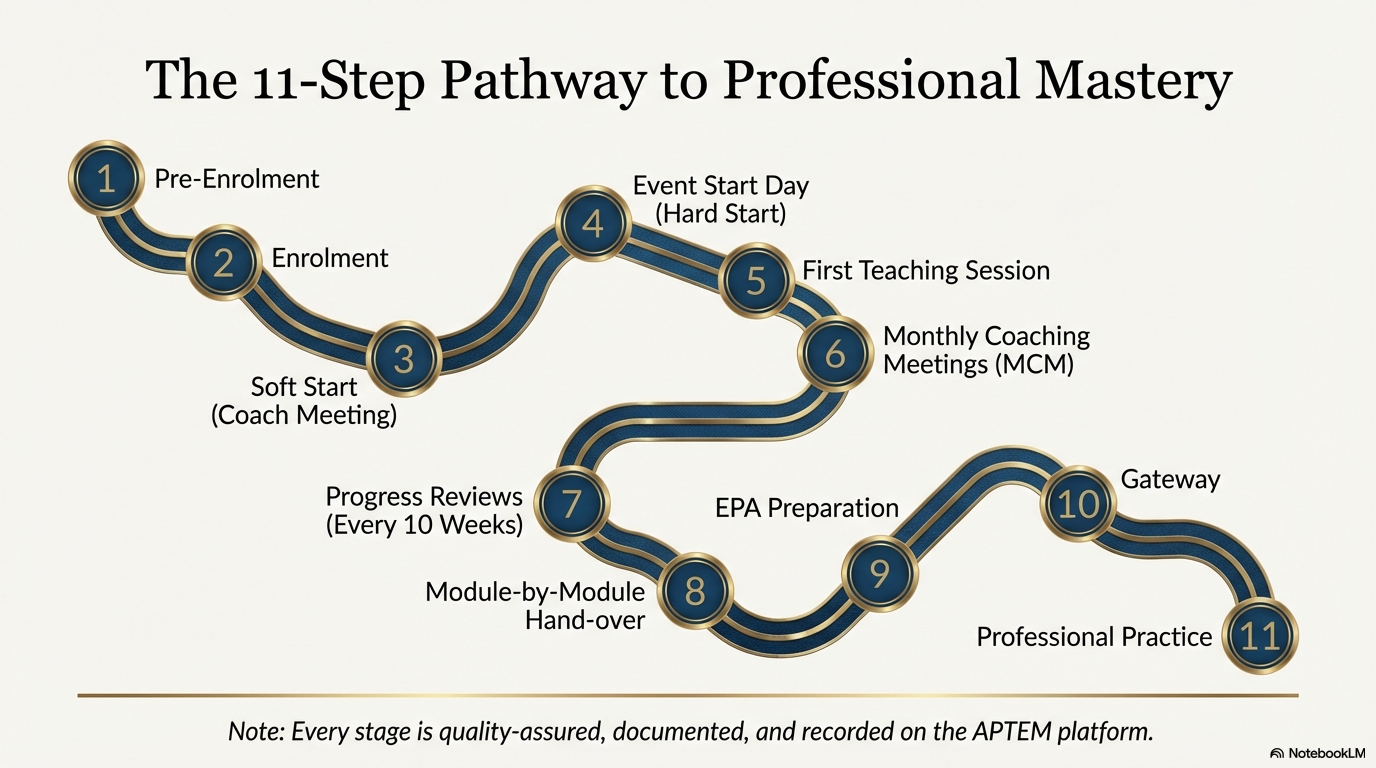
This internal guide provides a step-by-step walkthrough of the apprenticeship learner journey at Kent Business College (KBC), tailored for new Coaches. It outlines each stage of the process, the Coach’s responsibilities, and how Coaches collaborate with other key roles (Compliance Team, Enrolment Team, Employers, Teachers, etc.). Clear checklists, timelines, and tips are included to ensure you understand the end-to-end process. Use this manual to confidently guide your apprentices from initial enrolment through to End-Point Assessment (EPA), while maintaining compliance and a high-quality learner experience.


Learners must be employed by Kent Business College or formally engaged by Kent Business College as a:
Coach
Associate Coach
Tutor-Coach
Approved coaching associate
This course is not open to the general public and is designed exclusively for individuals delivering or preparing to deliver coaching services on behalf of Kent Business College.
Learners must be:
Actively coaching Kent Business College learners, or
Preparing to undertake coaching duties as part of their role
Learners must be willing to:
Participate in observed coaching practice
Receive professional feedback and supervision
Apply coaching approaches directly within Kent Business College programmes
Learners must demonstrate:
Commitment to Kent Business College values and professional standards
Ethical conduct, professionalism, and learner-centred practice
Willingness to engage in reflective practice and continuous improvement
Failure to meet professional standards may result in withdrawal from the course.
As this qualification leads to a learner-facing role, learners must:
Complete Safeguarding and Prevent training as required by Kent Business College
Agree to comply with all safeguarding, Prevent, and wellbeing policies
Undertake a DBS check, where required, prior to or during the programme
Learners must:
Attend all required training sessions, workshops, and supervision meetings
Complete all assignments, reflective logs, and assessments
Actively engage in Monthly Coaching Meetings (MCMs) and quality processes
Consistent engagement is required to remain on the programme.
Learners must:
Maintain accurate, timely, and evidence-based coaching records
Use Kent Business College systems (e.g. LMS, e-portfolio tools) as required
Contribute to Ofsted-ready, auditable learner evidence
Kent Business College reserves the right to:
Withdraw a learner from the course if:
Employment or engagement with the College ends
Professional or safeguarding standards are not met
Engagement or attendance requirements are not fulfilled
Completion of the course is conditional upon continued compliance with all requirements.